
The following article, Most Notable Media Lies of the Past Decades, was first published on The Black Sphere.
If the Fourth Estate once meant check your facts and double‑check your sources, then somewhere along the way it became check the narrative and amplify whatever fits.
I say this not as a punchline but as a history lesson that somehow became today’s headline. Let’s begin with the ghosts in the newsroom—the Stephen Glasses and Jayson Blairs of the early 2000s. These weren’t reporters with shaky memories. These were reporters who invented entire people, fabricated email chains, and sent editors on wild goose chases chasing stories that never happened. Stephen Glass concocted people, companies, events, even email accounts that only existed in his imagination, yet for months editors printed his stories as fact. When truth finally caught up, The New Republic fired him, and Hollywood turned it into Shattered Glass.
Then there was Jayson Blair, the New York Times wunderkind who never visited scenes he claimed to have witnessed, whose quotes came from thin air, and whose plagiarism was so blatant it forced a 7,000‑word front‑page confession from the paper itself.
Those moments should have been death knells for sloppy reporting. Instead, they became studio audience laughter tracks in the background of what we’ll now call the “fake news era.” Because the same outlets that once swore by multiple sourcing now parade anonymous sources like an amusement park ride—no verification necessary, just sheer thrill and spin straight out of the narrative handbook.
To understand just how bad things are, I’ve compiled the following:
Notable Journalists Involved in Fabrication or Debunked Stories (1980–2025)
|
Journalist Name
|
Publication
|
Date
|
Short Description of Transgression
|
Consequences
|
|---|---|---|---|---|
|
The Washington Post
|
1980
|
Fabricated the story “Jimmy’s World” about an 8-year-old heroin addict.
|
Won and returned Pulitzer Prize; resigned in disgrace; career ended.
|
|
|
BBC
|
1995
|
Used forged documents and deceptive tactics to secure Princess Diana interview for Panorama.
|
2021 independent inquiry condemned actions; resigned from BBC in 2021 amid health reasons but linked to scandal.
|
|
|
Stephen Glass
|
The New Republic
|
1998
|
Fabricated sources, quotes, events, and entire stories in at least 27 articles.
|
Fired; magazine issued apologies; disbarred from practicing law; inspired film “Shattered Glass”.
|
|
April Oliver and Jack Smith
|
CNN
|
1998
|
Produced retracted report “Operation Tailwind” falsely claiming U.S. use of sarin gas in Vietnam.
|
Both fired; CNN retracted story, apologized, and paid settlements to subjects.
|
|
Jayson Blair
|
The New York Times
|
2003
|
Fabricated and plagiarized in dozens of articles, including Iraq War and sniper stories.
|
Resigned; executive editor and managing editor resigned; NYT internal review exposed systemic issues.
|
|
BBC
|
2003
|
Reported UK government “sexed up” Iraq dossier.
|
Resigned following Hutton Inquiry criticism; BBC Director-General and Chairman also resigned.
|
|
|
Judith Miller
|
The New York Times
|
2002–2003
|
Promoted debunked Iraq WMD claims based on unreliable sources.
|
Resigned in 2005 amid controversy; NYT issued editor’s note critiquing coverage.
|
|
Alessandra Stanley
|
The New York Times
|
2005–2009
|
Multiple factual errors in articles.
|
Multiple corrections issued; left TV criticism role in 2010.
|
|
Dylan Ratigan
|
MSNBC
|
2009
|
Aired undisclosed photoshopped images of Sarah Palin.
|
On-air apology; no further major repercussions reported.
|
|
Lynn Hirschberg
|
The New York Times
|
2010
|
Took quotes out of context in M.I.A. profile.
|
Editor’s note and correction issued.
|
|
Andrea Mitchell
|
MSNBC
|
2012
|
Broadcast doctored video of Mitt Romney.
|
Network issued clarification.
|
|
Sarah Maslin Nir
|
The New York Times
|
2015
|
Nail salon series with misquotes, errors, and overstated claims.
|
Extensive rebuttals; partial retractions and corrections; no resignation.
|
|
Tom Hamburger, Devlin Barrett, Rosalind S. Helderman
|
The Washington Post
|
2017
|
Story falsely identifying Sergei Millian as Steele dossier source.
|
References to source removed in 2021 update.
|
|
Thomas Frank, Eric Lichtblau, Lex Haris
|
CNN
|
2017
|
Retracted story on Trump aide and Russia ties.
|
All three resigned; CNN retracted and deleted story.
|
|
Rukmini Callimachi
|
The New York Times
|
2018–2020
|
“Caliphate” podcast with unverifiable/fabricated claims.
|
Podcast retracted; returned Peabody Award; reassigned from terrorism beat.
|
|
Antonio Olivo, Cleve R. Wootson Jr., Joe Heim
|
The Washington Post
|
2019
|
Flawed Covington Catholic story portraying teens as aggressors.
|
Editor’s note admitting inaccuracies; WaPo settled defamation lawsuit with student.
|
|
Nikole Hannah-Jones
|
The New York Times
|
2019
|
1619 Project with historical inaccuracies.
|
Corrections issued; ongoing debates; tenure controversy at UNC.
|
|
Ben Popken and Robert Windrem
|
MSNBC/NBC
|
2019
|
Story claiming Russian bots boosted Tulsi Gabbard, based on disputed data.
|
Story criticized; no formal retraction reported.
|
|
David Culver
|
CNN
|
2019
|
Misreported Essex truck victims as Chinese (later Vietnamese).
|
Correction issued.
|
|
Alex Marquardt
|
CNN
|
2021
|
False implications in Kabul airlift story.
|
Defamation lawsuit settled.
|
|
Taylor Lorenz
|
The Washington Post
|
2022
|
Falsely claimed contact with sources in influencer article.
|
Two public corrections and stealth edits.
|
|
Simon Jack
|
BBC
|
2023
|
Inaccurate report on Nigel Farage’s account closure.
|
BBC issued apology and correction; internal review.
|
|
Clarissa Ward
|
CNN
|
2024
|
False details and staged elements in Syrian prison report.
|
Criticism and debunking; no formal retraction yet reported.
|
|
Jake Tapper and Dana Bash
|
CNN
|
2024
|
Falsely claimed Rashida Tlaib accused Dana Nessel of bias due to Jewish identity.
|
Debunked; no formal correction reported.
|
|
Tara Copp and Michelle Boorstein
|
The Washington Post
|
2025
|
Claimed U.S. Coast Guard downgraded swastikas/nooses as hate symbols.
|
DHS denounced as “unequivocally false”; story updated/corrected.
|
Those scandals were treated as bugs, not features. The lesson the industry learned was not “verify harder,” but “manage fallout better.”
Fabrication stopped being a moral failure and became a PR problem. And once the digital age arrived, outrage cycles shortened, corrections got buried, and accountability faded into the footer.
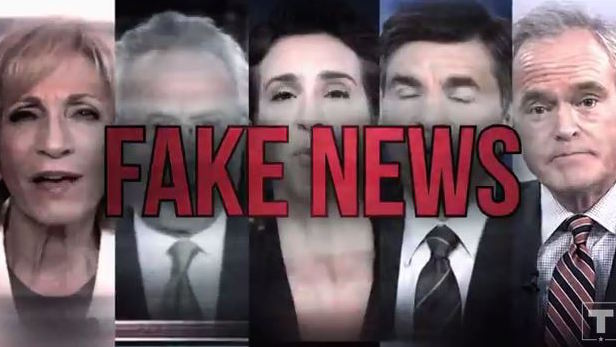
This is where Donald Trump enters the story. When he repeatedly used the phrase “fake news,” the media scoffed, mocked, and recoiled. But he wasn’t inventing a problem. He was naming one. Trump didn’t create distrust in the press; he articulated what millions already felt. That journalism had stopped reporting events and started authoring narratives.
The old fraudsters lied for ego, fame, or ambition. Today’s media lies for something far more dangerous: ideological cohesion. And unlike Glass or Blair, modern offenders are not fired. They are promoted, platformed, and protected.
The past scandals were individual sins. The present problem is institutional.
Take Russian collusion. For years, legacy outlets insisted Donald Trump was a Kremlin asset. Anonymous sources spoke with absolute certainty. Headlines dripped with implication. Breathless panels treated speculation as fact. And when the narrative collapsed under its own weight, when investigations failed to prove the core allegations, the reckoning never came.
Instead, the press doubled down. Pulitzers were awarded. Editors defended the coverage. Corrections were semantic, not substantive. The story wasn’t “we were wrong,” it was “we were technically justified.”
This same pattern repeats across issue after issue. Climate reporting turned complex, evolving science into apocalyptic certainty. Dissenting scientists were smeared as deniers. Failed predictions were memory-holed. And now, as newer data undermines decades of alarmist claims, the same outlets quietly soften language without acknowledging years of exaggeration and fear-peddling.
If outlets can reward stories that never proved their central claims, what’s stopping them from shaping reality instead of reporting it? That’s not hyperbole—that’s media history rewriting itself in real time, and today’s headlines are tomorrow’s forgotten corrections.
Continue reading Most Notable Media Lies of the Past Decades …