

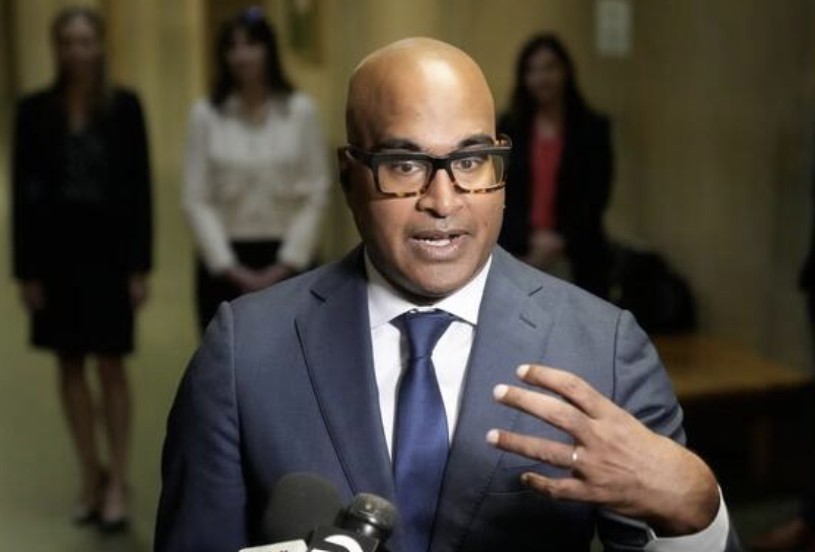
A legal OK-Corral-like standoff is occurring in the San Francisco legal system.
What makes the current standoff in San Francisco so revealing is not the surface-level dispute between a judge and a public defender, but the quiet absurdity embedded in the premise itself. A legal system that has spent years expanding obligations without expanding capacity has now arrived at a predictable conclusion, namely that reality is no longer cooperating, and must therefore be penalized. When Public Defender Mano Raju declines new cases because his office cannot ethically handle them, the court’s response is not to question the workload, but to fine him for noticing it.
At its core, the situation unfolds like a bureaucratic parable, one in which every participant is technically correct while the system itself becomes indefensible. Judges insist that cases must proceed, prosecutors continue filing charges, and defense attorneys are expected to absorb whatever volume emerges, as though constitutional rights operate on a subscription model that scales automatically with demand. The consequence, often ignored, is that the burden does not disappear; it concentrates, compressing into a single office now tasked with doing the impossible on a deadline.
According to reporting on the case, Raju was fined $26,000 after rejecting 26 cases in defiance of a January court order, with each refusal carrying a tidy $1,000 penalty.
What follows from this is not merely a disciplinary action, but a philosophical statement: the system would rather punish noncompliance than confront infeasibility. When the numbers stop adding up, the preferred solution is not recalculation, but enforcement.
Raju’s explanation, inconveniently grounded in arithmetic, undermines the entire performance. His claim that even halving caseloads would still leave attorneys overworked does not sound like advocacy; it sounds like a warning label. More importantly, his argument reframes the issue from one of professional preference to one of constitutional obligation.
A public defender is not a symbolic presence meant to satisfy procedural optics, but a functional necessity required to ensure that legal representation is meaningful rather than ceremonial.
What emerges, then, is a system attempting to mandate quality while structurally guaranteeing its absence. The court orders representation; the defender explains that representation without capacity becomes fiction; the court responds by insisting that fiction will proceed on schedule. Somewhere in that loop, the idea of justice begins to resemble theater, with each actor dutifully delivering lines that no longer correspond to reality.
The irony deepens when one considers the broader political environment that produced this moment.
For years, San Francisco’s legal philosophy has emphasized expanded protections for defendants, often framed as a moral correction to past excesses. Yet those protections, once translated into actual legal work, require time, attention, and human labor, none of which can be conjured through policy declarations alone. A right that demands resources without securing them does not expand justice; it dilutes it.
More interesting still is the collision between Raju and District Attorney Brooke Jenkins, which introduces a second layer of contradiction. Jenkins has argued that refusing cases disrupts the system and risks releasing defendants without representation, a concern that is both valid and revealing. If the system depends on overextension to function, then its stability is already an illusion. In effect, one side is arguing that the machinery must keep running, while the other is pointing out that the machinery has been overheating for quite some time.
Historically, this tension is not new, though it is rarely displayed so openly. The landmark case of Gideon v. Wainwright established the right to counsel as a constitutional guarantee, a decision that reshaped the legal landscape while quietly imposing an enduring logistical challenge on states.
What Gideon did not provide, however, was a mechanism to ensure that the right could be delivered at scale under every conceivable condition. That responsibility fell to states, many of which have treated public defense funding as an afterthought, resulting in a system where ideals expand while infrastructure lags behind. San Francisco, for all its ambitions, appears to have followed this pattern with particular enthusiasm.
Raju’s refusal, therefore, functions less as rebellion and more as a refusal to participate in what might be called procedural fiction.
By declining cases he believes cannot be handled competently, he forces the system to confront a question it has long avoided: is it better to process cases poorly or to admit that processing them properly requires limits? The court’s answer, at least for now, appears to favor throughput over integrity, a choice that carries consequences beyond any single courtroom.
The presence of public defenders from across California in support of Raju suggests that this is not an isolated dispute, but a pressure point for the entire system. When professionals accustomed to managing heavy caseloads begin to draw lines, it indicates that the margin for adaptation has been exhausted. Solidarity, in this context, is not merely symbolic; it is diagnostic.
What makes the situation particularly striking is the inversion of roles it produces. Those advocating for expanded rights now find themselves enforcing conditions that undermine those very rights, while the individual resisting compliance does so in the name of preserving them. It is a reversal that would be amusing if it were not so consequential, a kind of institutional self-contradiction that manages to be both logical and untenable at the same time.
The broader implication is difficult to ignore.
Systems that operate on accumulated assumptions eventually encounter a point where those assumptions collide, and when they do, the response reveals more than the policies themselves ever could. In San Francisco, the response has been to fine the person pointing out the collision, as though acknowledgment were the true offense.
Meanwhile, the practical reality continues to assert itself with quiet persistence. Cases do not become simpler because they are numerous, defendants do not receive better representation because it is mandated, and attorneys do not acquire additional hours because a judge insists upon it. These are not political variables; they are constraints, and they tend to reassert themselves regardless of ideology.
If there is a lesson embedded in this episode, it is not merely that the system is strained, but that it has reached a point where strain can no longer be concealed through rhetoric or procedural insistence. When compliance requires abandoning the premise of the job, refusal becomes not just understandable, but inevitable.
In the end, the fine levied against Raju reads less like a solution and more like a placeholder. A temporary assertion of control in a situation where control is already slipping. Whether the appeal succeeds or the fines escalate, the underlying issue remains untouched, waiting patiently for its next opportunity to surface.
Because eventually, even the most carefully constructed system runs into a simple, immovable fact.
Math still works.