
Coincidences, like smoke curling from cigars in a backroom poker parlor, tend to linger just long enough to make you wonder what game was really being played.
And when the haze clears, what’s left behind often tells a more honest story than the spectacle itself.
Consider the curious case of Hunter Biden, a man who, not long ago, was treated as a sort of modern-day Leonardo da Vinci by certain corners of the elite class.
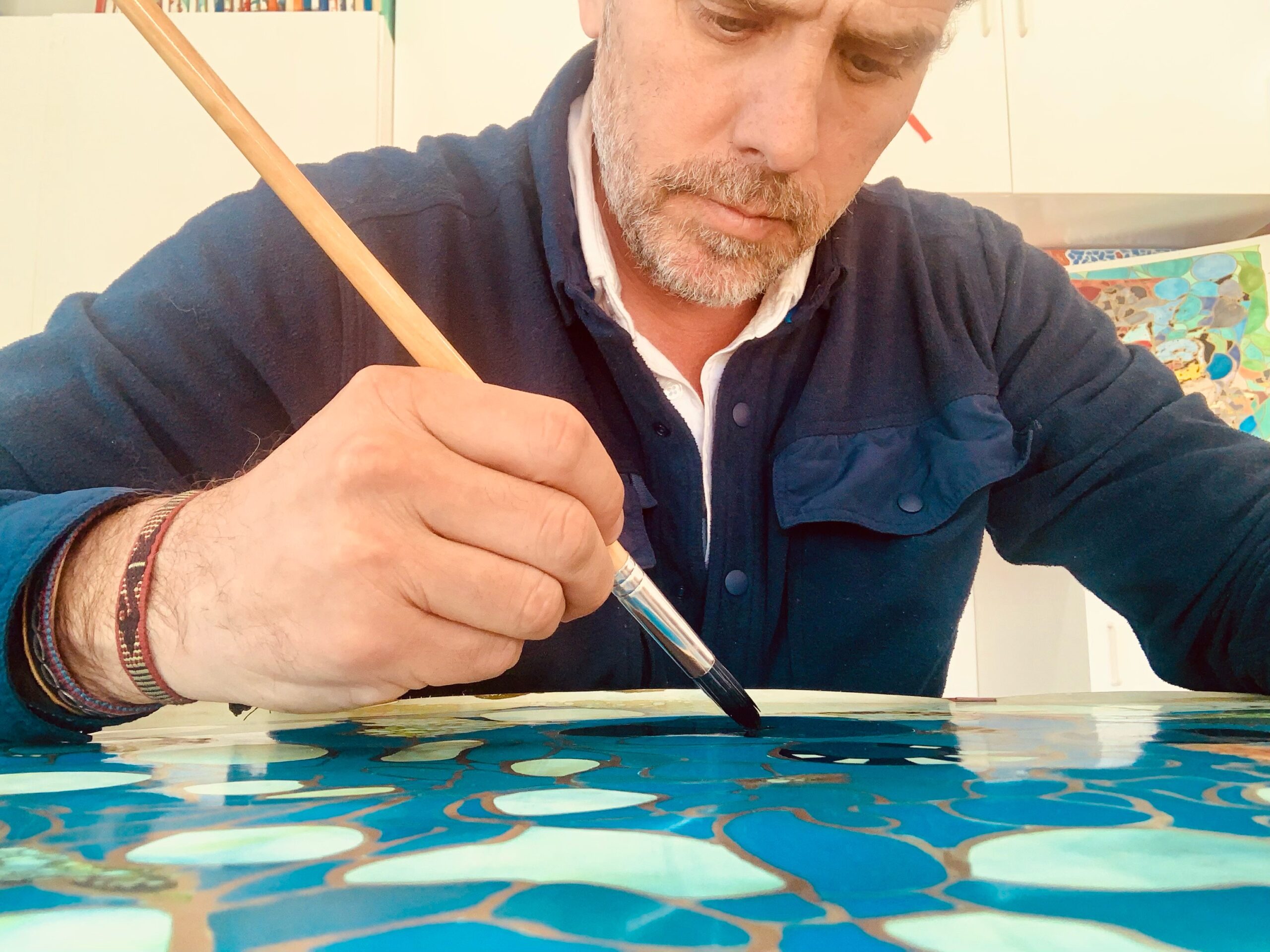
His “art” commanded prices that would make seasoned collectors blink twice and check their glasses. Paintings, we were told, selling for tens or even hundreds of thousands of dollars, often to anonymous buyers whose identities were conveniently shielded under the guise of ethics protections.
Yet, as time has marched on and the political winds have shifted, something peculiar has happened. The marketplace that once treated Hunter Biden’s canvas scribbles like sacred relics has gone eerily quiet.
No new headlines. No sold-out exhibitions. No breathless coverage of the next masterpiece. The man who was briefly positioned as an artistic phenomenon now appears to have exited stage left, leaving behind little more than a faint outline where a career was supposed to be.
That silence, unmistakably, speaks louder than the hype ever did.
Because if the value was real, it would persist. Markets, especially those involving art, may be subjective, but they are not imaginary. Even lesser-known artists, once they achieve a certain tier of recognition, tend to maintain at least a baseline level of demand. Their names circulate. Their works resurface. Their collectors remain engaged.
Hunter Biden, by contrast, seems to have evaporated from that ecosystem entirely.
And it doesn’t stop at art.
There was a time, not so long ago, when Hunter Biden’s résumé read like a globalist bingo card. Board seats, particularly in Ukraine, most notably with Burisma, positioned him as an international businessman of remarkable reach. The problem, as many observed even then, was not merely the existence of those roles, but the glaring absence of relevant expertise that would justify them. Energy sector experience? Minimal. Regional specialization? Dubious. Strategic value beyond the Biden name? That, as always, remained the unspoken assumption.
Now, however, those roles are gone. The board seats have vanished. The international engagements have dried up. Even the quiet hum of “consulting” work appears to have dissipated into the same void that swallowed his art career.
One is left to ask, not rhetorically but quite directly: what changed?
The answer, while uncomfortable, is hardly complex. Political gravity shifted. The orbit collapsed.
For years, Hunter Biden operated within the gravitational pull of Joe Biden, a force that, at its peak, provided not just visibility but leverage. Access, whether explicit or implied, functioned as a kind of currency, one that opened doors, facilitated deals, and, perhaps most importantly, signaled to others that proximity to power was within reach.
When that gravitational force weakens, the satellites it once held in place do not gently drift. They fall.
And fall he has.
The media, predictably, has shown little appetite for exploring this trajectory in any meaningful way. Coverage that once bordered on defensive advocacy has now shifted into something closer to benign neglect. Hunter Biden is no longer a figure to be celebrated, nor is he one to be scrutinized. Instead, he has become something far more convenient: irrelevant.
But irrelevance, in this context, is not a neutral state. It is, rather, a verdict.
Because if Hunter Biden were truly a business mogul, as some narratives attempted to suggest, then his career would not be so tightly tethered to his father’s political fortunes. Entrepreneurs, genuine ones, build systems that outlast individual administrations. Artists, legitimate ones, cultivate audiences that persist beyond moments of novelty. Professionals, credible ones, develop reputations that carry weight regardless of who occupies the Oval Office.
Hunter Biden, it seems, has done none of these things.
Even his much-publicized “redemption arc,” the story of a man overcoming addiction to reclaim his life and build a thriving enterprise, now feels less like a narrative of resilience and more like a carefully curated storyline that required a very specific set of conditions to remain believable. Remove those conditions, and the narrative collapses under its own weight.
What remains is a question that cuts through the noise with surgical precision: if the talent was real, where did it go?
One could argue, of course, that stepping out of the limelight is a personal choice, a deliberate retreat from public scrutiny. That explanation, while superficially plausible, fails to account for the abruptness and completeness of the disappearance. People who choose privacy do not typically abandon entire industries overnight. They scale back. They recalibrate. They maintain some level of engagement, even if only quietly.
Hunter Biden, by contrast, has not recalibrated. He has vanished.
And then there is the matter of comparative value. If, hypothetically, Hunter Biden were to host an art exhibition today, what would happen? Would collectors line up once more, eager to acquire his latest creations? Or would the response more closely resemble that of a struggling artist along Venice Beach, where talent competes not with prestige but with foot traffic and spare change?
The answer, while speculative, feels increasingly obvious.
Because markets, unlike media narratives, have a way of correcting themselves.
They strip away the excess, the hype, the artificially inflated valuations, and in doing so, they reveal something far more grounded. What people are actually willing to pay. What they genuinely believe something is worth. What remains when the spotlight dims and the stage empties.
In Hunter Biden’s case, that correction appears to have been swift and unforgiving.
And yet, despite all of this, the broader conversation remains curiously muted. The same outlets that once insisted on the legitimacy of his ventures now seem content to let the story fade into obscurity, as though silence itself could function as a form of resolution.
It cannot.
Because the implications extend beyond one individual.
They touch on a larger, more systemic issue, one that involves the intersection of power, influence, and accountability. When access to political figures can be monetized, whether directly or indirectly, it creates an environment where merit becomes secondary to proximity. Opportunities are not earned but granted. Value is not demonstrated but assumed.
And when that system is exposed, even partially, the instinct is not to confront it, but to bury it.
Hunter Biden’s disappearance, in that sense, is not merely a personal story. It is a case study.
A demonstration of what happens when the scaffolding of influence is removed, leaving behind whatever foundation actually exists. In this instance, that foundation appears to be remarkably thin.
Of course, none of this should come as a surprise.
The signs were always there, scattered like breadcrumbs for anyone willing to follow them. The inflated art prices. The questionable board appointments. The media’s reluctance to ask even the most basic questions. Each element, on its own, might have been dismissed as an anomaly. Taken together, however, they painted a picture that is now coming into sharper focus.
And that picture is not flattering.
It suggests that Hunter Biden’s rise was less about individual achievement and more about situational advantage. That his success was not built, but bestowed. That his value, in many respects, was contingent rather than intrinsic.
Remove the contingency, and the value disappears.
Which brings us back to the original question, the one that lingers like an unresolved chord: coincidence?
Hardly.