

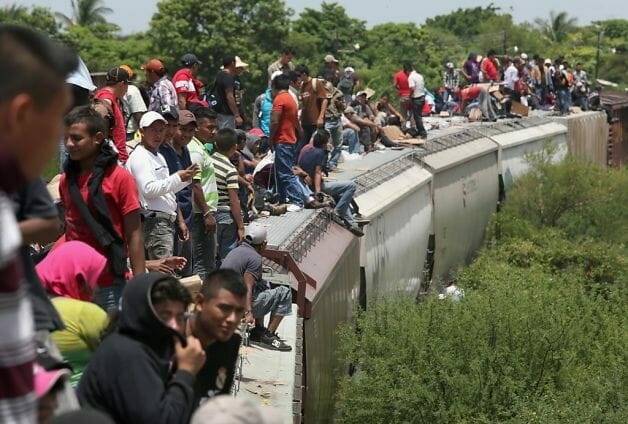
Somewhere in the not-so-distant past, a cultural experiment strutted onto the national stage with all the theatrical flair of a Broadway opening.
It was called “A Day Without a Mexican,” a protest-meets-performance-art moment. The premise was simple, almost cinematic in its ambition: remove Mexican labor from America for a day and watch the nation descend into chaos. Crops would rot, homes would crumble, and suburban households would be forced to confront the existential horror of…folding their own laundry.
It was activism wrapped in satire, dipped in a heavy glaze of political messaging. And like many such spectacles, it relied less on data and more on dramatic imagination.
Fast forward to today, where reality has conducted its own unscripted sequel: a de facto “Day Without 3 Million.” Not all Mexican, not even close, but that detail barely dents the narrative. The core claim was always broader than nationality. It was about dependence. It was about necessity. It was about the idea, repeated so often it calcified into dogma, that America simply could not function without a vast underclass of illegal labor doing the jobs “Americans won’t do.”
Well… cue the plot twist.
Because not only did America function, it adjusted. It recalibrated. It did what it has always done when faced with disruption: it adapted like a living organism that refuses to die.
Let’s address the sacred talking point first, the one delivered with the solemnity of a sermon: “Americans won’t do these jobs.”
You’ve heard it from pundits, politicians, and the occasional celebrity who hasn’t personally done a day of manual labor since the Reagan administration. According to this worldview, Americans would rather binge-watch streaming shows than pick crops, weld steel, or fix plumbing.
Except… that’s not what the evidence shows. This piece from National Review tells a story that doesn’t fit neatly into the narrative, which is precisely why it matters.
Pierette Swan, a straight-A student with a fine arts degree, found herself staring into the economic void of 2008. Her degree, polished and prestigious, suddenly had the market value of a decorative paperweight. So she pivoted. Welding. Not exactly the glamorous fallback plan sold in glossy college brochures.
And yet, she didn’t just survive, she thrived.
She described welding as intellectually stimulating, a craft that engages both mind and body, offering tangible results in a world increasingly dominated by abstract digital output. In other words, she found meaning. Purpose. A career.
That story isn’t an anomaly. It’s a preview.
The narrative collapse isn’t just about labor. It’s about perception.
For decades, American culture has quietly, persistently nudged young people toward a single path: college. Not just education, but that kind of education. Four years. A degree. Preferably something that sounds impressive at dinner parties, even if it translates poorly into actual employment.
Meanwhile, trades were cast as the understudies. The backup plan. The realm of grease-stained overalls and backbreaking toil.
But reality, stubborn as ever, has begun flipping that script.
Trades today are experiencing something that feels suspiciously like a renaissance. Electricians, welders, plumbers, HVAC technicians, these aren’t fallback options anymore. They’re increasingly seen as smart, strategic career moves. They pay well. They offer stability. And perhaps most importantly, they can’t be outsourced to a server farm or replaced by an algorithm… at least not anytime soon.
Contrast that with the looming shadow of AI, which is quietly circling many white-collar professions like a shark that just discovered spreadsheets.
The irony is almost poetic.
We were told the future belonged to the knowledge economy, to the coders and consultants and middle managers of endless meetings. And yet here we are, staring at a horizon where the guy who can fix your electrical panel might be more indispensable than the guy who can optimize your slide deck.
Now, let’s revisit the emotional core of the original argument.
The imagery wasn’t just about labor shortages. It was about identity. About dignity. About recognizing the contributions of immigrant communities, often framed through figures like Cesar Chavez, whose legacy in labor rights is undeniably significant.
And that’s where things get nuanced.
Because acknowledging the contributions of immigrants, legal or otherwise, does not require accepting the premise that America is dependent on illegal labor to function. Those are two entirely different claims, often bundled together for rhetorical convenience.
One is about respect. The other is about necessity. And necessity, as it turns out, is a much harder argument to sustain when the system doesn’t collapse in its absence.
Let’s talk about those “jobs Americans won’t do.”
The phrase itself is a kind of linguistic sleight of hand. It implies not just unwillingness, but a permanent, almost cultural aversion. As if American workers are fundamentally allergic to certain types of labor.
But history tells a different story.
Americans built railroads. They worked factories. They mined coal, forged steel, and constructed skyscrapers that scrape the sky like declarations of defiance. The idea that this same population suddenly developed an aversion to physical work isn’t just questionable, it’s historically absurd.
What changed wasn’t the workers. It was the incentives.
If wages are suppressed, if working conditions are poor, if opportunities for advancement are limited, then yes, people will look elsewhere. Not because they’re unwilling, but because they’re rational.
Raise wages. Improve conditions. Create pathways for growth. Suddenly, those “undesirable” jobs start looking a lot more…desirable.
Funny how that works.
And then there’s the cultural layer, the part that rarely gets said out loud but hovers in the background like a knowing smirk.
The same voices insisting that illegal labor is essential often belong to those who benefit from it most directly. The manicured lawns and spotless homes. The convenience economy built on the backs of underpaid workers who exist in a kind of legal gray zone.
It’s a system that quietly serves the affluent while being publicly defended as a moral imperative.
That contradiction doesn’t just whisper. It echoes.
So what happens when you remove millions of workers from that system? According to the old narrative, everything should fall apart.
According to reality, things shift.
Wages adjust. Employers adapt. Workers step in. Technology fills gaps where it can. It’s not seamless, and it’s not without friction, but it’s far from the apocalyptic scenario we were promised.
America, for all its flaws, has an almost irritating tendency to figure things out.
It doesn’t just survive. It recalibrates, evolves, and ultimately thrives.
Now imagine a future where the cultural hierarchy flips completely.
Where trades are seen as elite professions, requiring skill, precision, and intelligence, while certain white-collar roles are viewed as… optional. Replaceable. Maybe even quaint.
It sounds improbable until you realize it’s already starting.
The welder, the electrician, the builder, these aren’t relics of a bygone era. They’re the backbone of a future that still needs things to be made, fixed, and maintained in a physical world that stubbornly refuses to become entirely virtual.
And the college graduate with a degree in something abstract and a job that can be automated? That future might be a little less certain.
So yes, we had “A Day Without a Mexican.”
And now, in a broader sense, we’ve had something like a day without millions of illegal workers.
The republic didn’t crumble. Further, the economy didn’t implode, and yes, the lights stayed on.
Not because those workers didn’t matter, but because America is bigger than any single labor pool. It’s a system, messy and imperfect, that adjusts under pressure and finds equilibrium in ways that defy tidy narratives.
Which brings us to the uncomfortable conclusion.
The original premise, that America cannot survive without illegal labor, wasn’t just overstated. It was wrong.
And in the quiet, unspectacular way that reality tends to operate, that truth has been revealed not through protest or performance, but through simple, undeniable continuity.
The machine kept running. Not flawlessly. Not effortlessly. But indeed undeniably.